
Why Does My Measured Bra Size Still Feel Wrong?
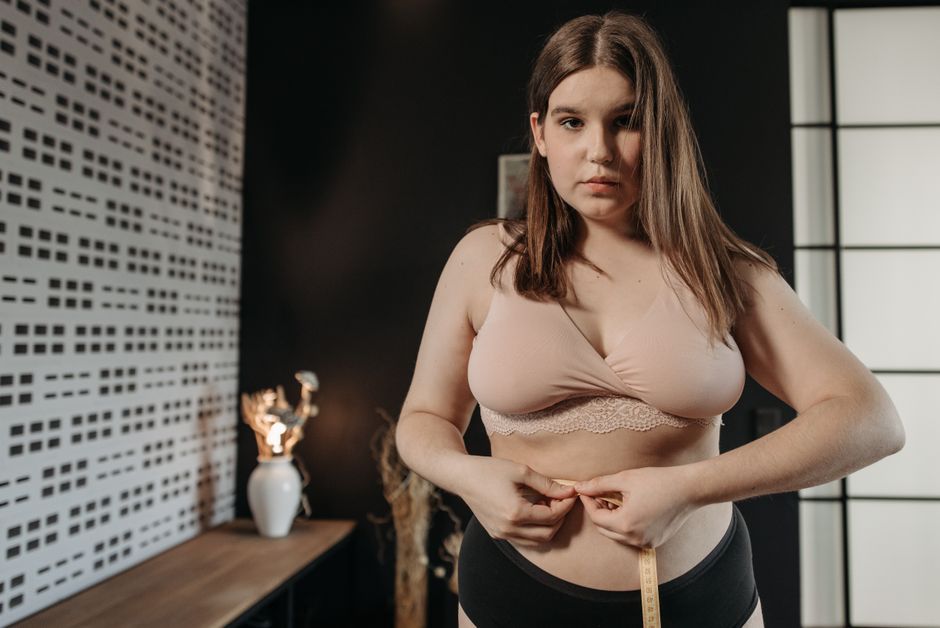
A measured bra size is a starting point, not a verdict. If the band climbs, cups gape, wires shift, or the center does not sit flat, diagnose that specific symptom before changing the whole size. Band tension, sister sizing, breast shape, and bra construction can all change the result, even when the label matches your measurements.
The useful shift is simple: stop treating every discomfort as a full-size failure. Read the bra in components. A research team comparing conventional measurements with professional fitting criteria in 45 participants found significant differences in both band and cup size, and concluded that less emphasis should be placed on finding an absolute size. The label gets you to the fitting room. The symptoms tell you what to do next.
Why does my bra band ride up even when I was professionally fitted?
A band that rides up usually needs more tension at the band, not tighter straps. The National Breast Cancer Foundation fit guide directs wearers with a riding-up band to go down one band size and up one cup size, using 34C to 32D as its example.
Run the band-first check. Fasten a new bra on its loosest hook, because that is where the guide says a new band should fit firmly before wear stretches it. Then loosen the straps enough that they are not trying to carry the job of the band. If the back still rises while the front does not stay in place, test the adjacent smaller band and corresponding sister cup.
| Fit symptom | Likely component to inspect | Next try-on move |
|---|---|---|
| Back band rides upward | Band tension | Try one band size down and one cup size up. |
| Straps leave the fit feeling unstable | Straps and band | Reset the band first, then adjust straps only for position. |
| Spillover or a lifted center section | Cup capacity | Test more cup room after confirming the band. |
| Wrinkling or gaping | Cup shape or style | Compare a different construction before automatically sizing down. |
| Wires poke, ride up, or slide down | Cup, wire, and front band | Check where the wire sits and reassess the component that is failing. |
Do not overcorrect. A firmer band may fix the climb while exposing a cup or wire problem that was previously masked by looseness. That is useful information, not a failed fitting. Research on 309 women found incorrect fit especially common in cups, front bands, and straps, with differences by breast-size group for front bands, underwires, and straps. Separate symptoms can have separate causes.
What do I do if my cups gape but a smaller cup cuts in?
If a smaller cup cuts in while the current cup gaps at the top, change the bra style before assuming the cup volume is wrong. The National Breast Cancer Foundation specifically identifies breast shape and bra style as a common cause of top-cup gaping when the rest of the bra fits.
This is the shape-versus-volume test. First, settle breast tissue into the cup with a scoop-and-swoop check. Then assess the whole cup, not just the top edge. If the breast is contained, the wire is in the intended position, and only the upper edge has space, compare another cup construction in the same labelled size rather than immediately moving to a smaller cup.
Use the symptom language precisely when shopping online: “The top edge gaps, but a smaller cup cuts in.” That sentence carries more useful information than “my size is wrong.” It tells a retailer or fitter that the issue may be construction and breast shape, not simply capacity. For a related wardrobe-fit lens, see How Can I Find Comfortable, Current Clothes That Fit After 60?.
There is solid reason to take shape seriously. In a 3-D body-scanning study of 103 college women, researchers classified shoulder slope, bust prominence, back curvature, and acromion placement, and found significant interactions with poor support and motion restriction. Labelled size does not capture every physical variable that changes how a bra sits.
How do sister sizes work when my usual bra size is unavailable?
Sister sizing means changing one band size while moving one cup size in the opposite direction: 34C, 36B, and 32D are a related family. It is a practical availability tool, not a promise that each option will fit the same.
Use it in a tight sequence. If your usual size is unavailable, select only one adjacent sister size, then recheck the band, cup edge, underwire position, straps, and center section. Do not jump multiple steps because each band change also changes the garment’s tension and proportions.
- Pick one direction. For a smaller band, move one cup letter up; for a larger band, move one cup letter down.
- Start on the loosest hook. That preserves room for ordinary band stretch over time.
- Run a movement check. Sit, raise your arms, and watch for band climb, cup cutting, wire movement, and strap pressure.
- Record the failure, not just the size. Write “band stable, top gaps” or “cup contains, wire slides.” That reduces repeat ordering errors.
The distinction matters. A textile-apparel pressure study found that 32D and 34C, despite being sister sizes, produced different pressure patterns at the underwire and shoulder straps, corresponding with differences in breast-base shape. The researchers’ conclusion is blunt: sister sizes can be linked on a size chart and still feel completely different on the body.
That also explains why a professional fitting is valuable but not final. In the 45-participant Ergonomics study on professional bra-fitting criteria, traditional measurements overestimated band size and underestimated cup size, with the mismatch increasing as band size increased. A fitting appointment should give you a testable baseline. Your next step is to confirm it in the specific bra construction you plan to keep.
Before removing tags, run one repeatable drill: test the loosest hook, settle the tissue, check each component in a mirror, then move through ordinary positions. Keep a two-column note: “what worked” and “what failed.” The next order should change one variable on purpose, not five variables by accident.
Frequently Asked Questions
Why do underwires dig in or slide down during the day?
Underwires that poke, ride up, or slide down are listed by the National Breast Cancer Foundation as signs that the bra may be too small. Check the band, cup containment, and whether the wire follows the breast base rather than sitting on breast tissue. The component study of 309 women also found that front-band and underwire fit problems can vary separately, so changing only the cup letter may not solve the issue.
Can the right bra size still be wrong for my breast shape?
Yes. Research using 3-D body scanning found that physical characteristics such as shoulder slope, bust prominence, back curvature, and acromion placement interact with support and motion-restriction problems. The National Breast Cancer Foundation also identifies breast shape and bra style as a common reason for top-cup gaping when the rest of the bra fits.
How should I test a new bra before removing the tags?
Keep the tags on and test the bra on the loosest hook, because a new band should fit firmly there before it stretches with wear. Adjust the straps, place breast tissue into the cups with a scoop-and-swoop check, then move, sit, and raise your arms while watching the band, cups, wires, straps, and center section. If one component fails, record that symptom before ordering another size or style.
Sources
- PubMed: Evaluation of professional bra fitting criteria for bra selection and fitting in the UK
- PubMed: Physical characteristics related to bra fit
- Clothing and Textiles Research Journal: Which Bra Components Contribute to Incorrect Bra Fit in Women Across a Range of Breast Sizes?
- International Textile and Apparel Association Proceedings: Effect of Bra Style and Size on its Fit and Comfort
- National Breast Cancer Foundation: How to Choose the Right Size & Type of Bra